
Which Monterey County Public Records Are Open
Access turns on the record and its custodian. The Monterey County Recorder publishes name indexes for recorded instruments, while the Superior Court offers a case portal and stronger access at clerk terminals. The Assessor publishes parcel facts but blocks public internet searches by owner name or address. Vital certificates use an authorized-copy and informational-copy system. Voter data requires a separate approved-use application, so it is not a casual open directory.
| Record group | Office that keeps it | Web coverage | Practical access |
|---|---|---|---|
| Deeds, liens, FBN and CEQA filings | Assessor-County Clerk-Recorder | Tyler 1978-present; Digital Reel 1850-1977 | Online index; copies at counter or by mail |
| Civil, family and probate cases | Monterey Superior Court | Current and completed cases back to 2008 | Portal, clerk computers, viewing room, mail |
| Assessment and parcel facts | Assessor and County GIS | Current parcel-based tools | Parcel or assessment number required |
| Birth, death and marriage copies | County Recorder; CDPH-VR statewide | No county public vital index found | In person, mail, or approved online vendor |
| Custody and offender data | Sheriff, CDCR and California DOJ | Current disclosed records | Official log or state lookup |
| Agency documents | Department holding the record | Varies by department | County request hub or agency request channel |
California law does not make every government file public. Sealed cases, juvenile and adoption records, confidential marriages, protected voter information, certain motor-vehicle data, Safe at Home addresses, and some registry entries remain closed or limited. The useful question is therefore not just whether a record exists. It is which version may be inspected and who may receive a copy.
Monterey County Recorder's Two Indexes
The Recorder's online document access page divides the name trail at 1978. Tyler Self-Service holds the current Official Records Index, Fictitious Business Names Index, and CEQA Index from 1978 forward. The separate Digital Reel system covers the historical Official Records Index from 1850 through 1977. Together, those systems trace the county recorder index back to county formation.
A grantor is the person who transfers an interest, while a grantee receives it. Search both roles and test spelling variants, initials, hyphenation, and prior surnames. The Tyler notice specifically advises trying all possible spellings. An index result points to a recorded instrument, but it is not the instrument image or a certified copy.
| Portal element | Type | Needed | Monterey detail |
|---|---|---|---|
| Disclaimer acceptance | Button | Yes | Select “I Accept” before entering Tyler |
| Current dataset | Index | Choose as needed | Official, FBN, and CEQA indexes, 1978-present |
| Name spelling | Search practice | Recommended | Try every plausible variation |
| Historical dataset | Digital Reel login | Yes | Official Records Index, 1850-1977 |
Note: The web inspection did not expose Tyler’s post-acceptance field labels, so no unverified search controls are represented here.
Order Monterey County Recorder Copies
An index hit becomes useful when it supplies enough detail to identify the source document. The Recorder asks for a document number or reel and page, recording year, the name of at least one party exactly as recorded, and document type. Copies cost $2 per page. Certification costs another $2 per document. A certified copy bears the custodian’s formal certification; it differs from a plain copy made for reading or family research.
The Recorder's copy and search instructions allow requests in person or by mail to Monterey County Recorder, P.O. Box 29, Salinas, CA 93902. Recorded real-property documents can also be viewed in the office public access area during published viewing hours, Monday through Friday, 8 a.m. to 5 p.m., except holidays and posted closures. This counter is the key fallback when Tyler or the Digital Reel login does not reveal enough to place a precise order.
- Document number, or reel and page
- Recording year
- At least one recorded party name
- Document type, such as deed, lien, or release
Monterey County Property Records Need Parcel IDs
The Assessor’s internet tools are not owner-name directories. Government Code section 6254.21 limits publication of home addresses and phone numbers for elected or appointed officials without permission, and Monterey County responds by allowing public assessment searches through parcel identifiers rather than name or address. The Property Value Notice accepts a fee parcel number or assessment number. A full number has 12 digits, and a partial search needs at least six, with no spaces or punctuation.
The Property Value Notice result can show ownership, parcel status, Tax Rate Area, assessed values, exemptions, and parcel characteristics. ParcelQuest Lite adds parcel details and map pages within its stated limit of 50 searches and 25 parcel maps per month. County GIS parcel reports add land use, zoning, hazards, critical habitats, and historical resources, though GIS layers may differ from official assessment rolls and surveys.
The ParcelQuest Lite agreement introduces the county-supported parcel channel and its monthly limits.
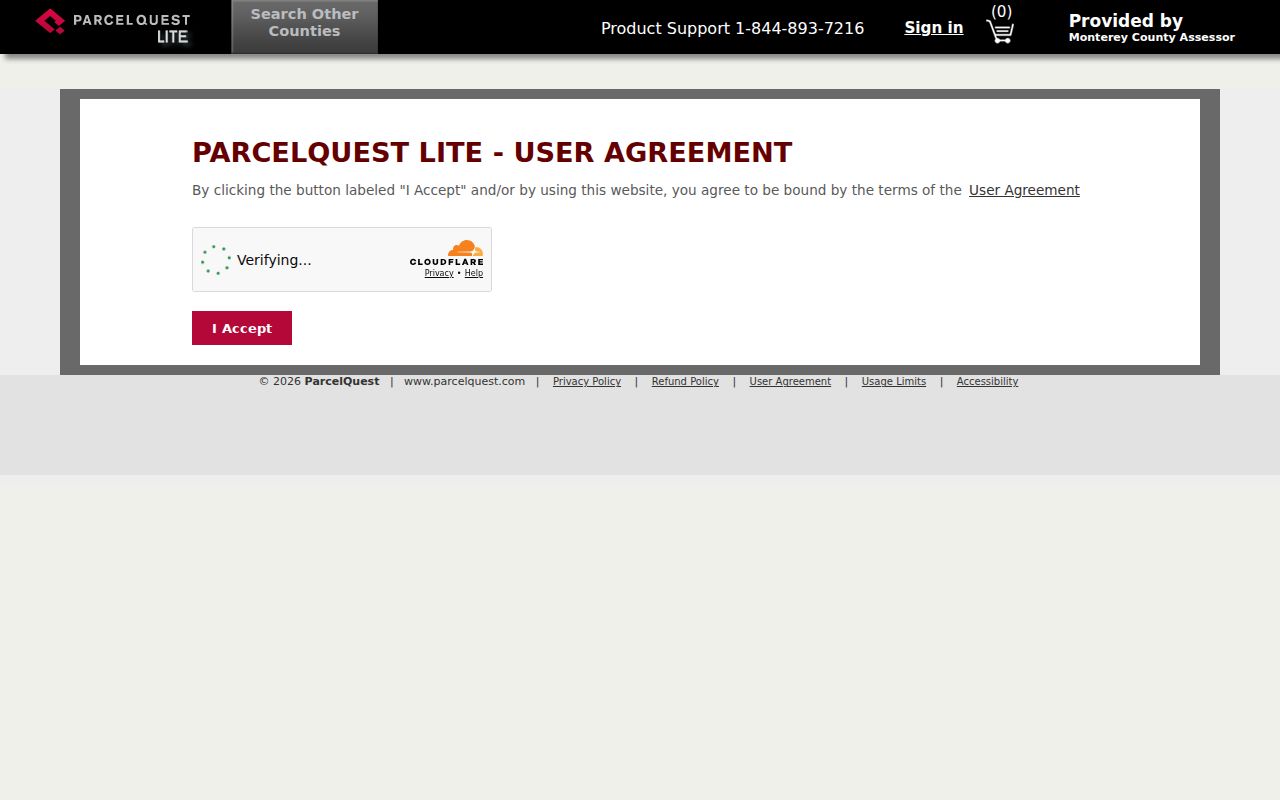
The agreement screen matters because it marks the terms readers accept before moving from a parcel number to assessment and map detail.
Monterey County Court Records Extend Offline
The Monterey Superior Court Public Portal covers current and completed cases back to 2008 without registration. It provides case information, hearing schedules, daily calendars, and criminal or traffic payment functions. Yet remote access is only one channel. California court rules presume court records open unless a file is confidential or sealed, and the clerk’s public computers expose indexes, calendars, and case record information that may not appear remotely.
For civil, family, and probate files, the court's record request process accepts searches in person or by mail, not by telephone. A search without a case number costs $15, as does work requiring more than ten minutes of clerk time. Copies are $0.50 per page. Standard court certification is $25 per document plus pages. Off-site retrieval costs $10 for up to three files and can take seven to ten days.
An especially useful local detail is that civil, family, and probate minute orders from July 9, 2012 forward can be read on public computers in the court viewing room. Historical non-confidential court files move farther offline: the court’s agreement with the Monterey County Historical Society places archived material there for access and duplication at cost.
Note: Mail searches go to the Monterey Courthouse records office and require the case details, request form, and applicable payment.
Monterey Vital Records Have Copy Tiers
Birth, death, and marriage certificates do not have a public county name index in the research. The fallback begins with the Recorder for events in Monterey County or with California Department of Public Health Vital Records for statewide custody. Requests may be made in person, by mail, or through the county’s approved online vendor. Mail requests for an authorized copy require the application, a notarized sworn statement, and payment by check or money order.
Health and Safety Code section 103526 separates authorized certified copies from informational certified copies. A person outside the authorized class may receive an informational birth, death, or non-confidential marriage copy marked as invalid for establishing identity. Confidential marriage copies are limited to a party to the marriage unless another law or order permits release. County fees are $31 for birth, $26 for death, and $19 for non-confidential marriage certificates. The online vendor adds a $12.95 processing charge per transaction.
Monterey County Records Offices
Salinas is the main county records hub. The Recorder and Assessor share one county department but manage different bodies of information. The Superior Court is a separate judicial custodian, and the Sheriff holds custody and incident material. Calling the correct office first can prevent a broad request from being routed between departments.
Assessor-County Clerk-Recorder
168 W. Alisal Street, 1st Floor
Salinas, CA 93901
Counter hours: 8 a.m.-12 p.m. and 1-5 p.m., Monday-Friday
The Recorder also accepts mailed document-copy requests. The court accepts mail requests for civil, family, and probate searches, while the Sheriff offers category links and a NextRequest channel. These options keep access available when an online index is absent or incomplete.
Note: Choose the custodian by record type before filing, since recorder, court, and Sheriff requests follow different forms, fees, and access rules.
Monterey Custody Records and Registry Limits
The Sheriff’s In Custody Log is a current table with booking number, name, date of birth, sex, age, arresting agency, and charges. Arrest records, incident reports, local criminal history, and broader agency files can use the Sheriff release links or the NextRequest portal. State prison custody is searched through CDCR’s CIRIS system, not the county jail log.
California’s official sex-offender registry discloses only the entries permitted by Penal Code section 290.46. Some posted records show a home address, some show only a ZIP Code, and some registrants are not published at all. Absence from the public result is not proof that no registration record exists.
The California Megan’s Law website presents its disclosure terms before a search.
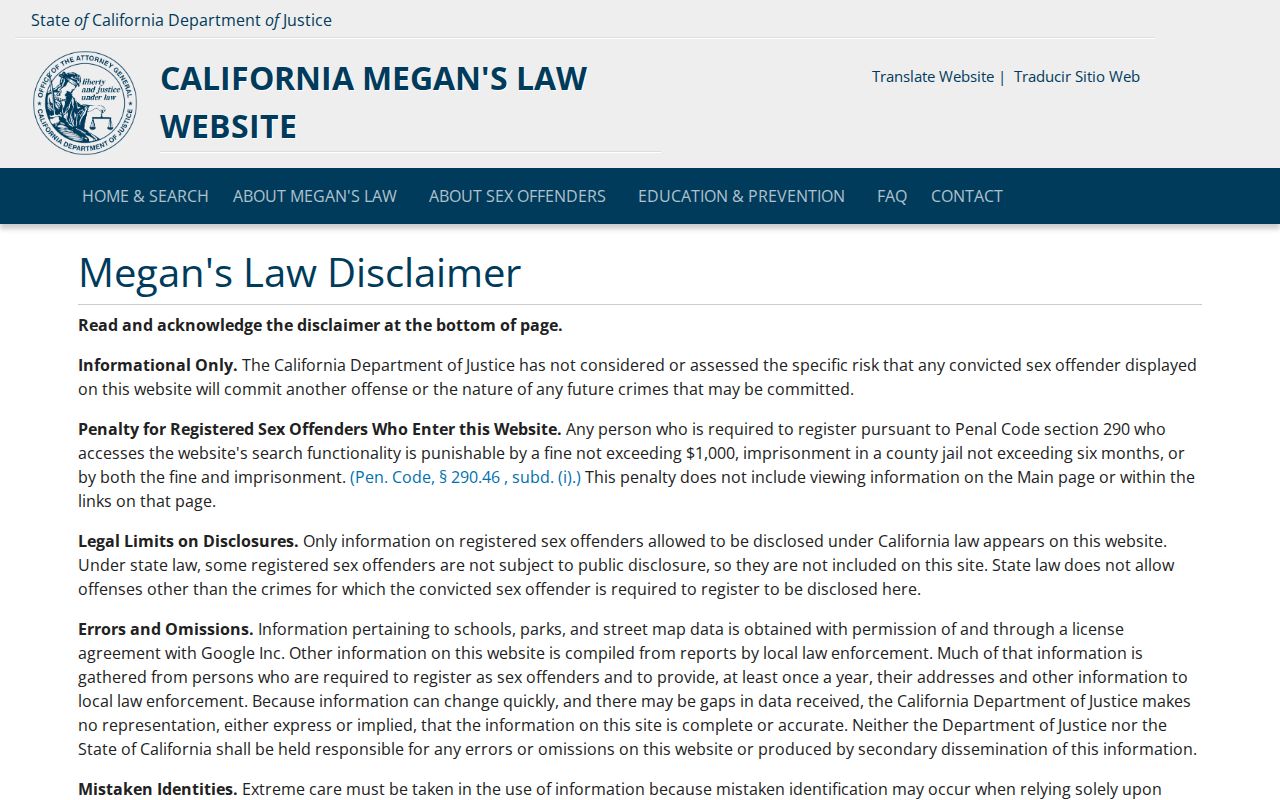
The notice is part of the access process because use of disclosed registry data to commit a misdemeanor or felony carries extra state penalties.
California Records Terms in Plain Words
Knowing what an office means by “search,” “copy,” and “exemption” helps set the right request. A portal may expose an index while the full document remains at the counter. A clerk may also redact protected facts from an otherwise open record.
- Custodian
- The agency or office responsible for keeping and responding for a record.
- Index
- A finding list with names, dates, numbers, or document types, not necessarily the record image.
- Certified copy
- A copy formally attested by the office, often for a higher fee than a plain copy.
- Exemption
- A law that permits or requires an agency to withhold specific information.
- Redaction
- Removal of protected details while the rest of the record is released.
A clear request can ask for an electronic copy, inspection, or certification. It should not assume that one fee or access rule applies across the Recorder, court, health records, and law-enforcement offices.
Restricted Monterey County Records
Several Monterey systems are intentionally narrower than their record titles suggest. Court files may be sealed or confidential. Juvenile and adoption matters have added barriers. The voter file is confidential and released only after an application for purposes recognized by California election law. Safe at Home gives eligible participants a substitute mailing address to help keep a residence out of government disclosures.
Vital records protect identity through copy tiers. The Assessor blocks name and address searching on its public site. Megan’s Law publishes only those registrants and location details that state law permits. These limits cannot be bypassed with a general California Public Records Act request because a specific confidentiality law controls.
Lawful personal use. Open records may support family history, estate research, civic review, or scam checks. Never use record details to stalk, threaten, harass, or harm a person.
Request Monterey County Public Records
The California Public Records Act is the fallback for an agency record that has no direct index or copy process. Monterey County’s public records access hub groups subjects and departments, while the Sheriff maintains its own request portal. A focused request should describe an identifiable record, likely office, date range, subject, and preferred format. It need not explain a personal motive.
- Identify the department most likely to hold the record. Use its direct copy process when one exists.
- Check the official index or posted documents first. Save names, file numbers, dates, and record types.
- Submit a narrow written request through the county hub, department portal, mail channel, or office counter.
- Ask for inspection or electronic delivery when suitable, and confirm any copy or certification cost before work begins.
- If part is withheld, ask the office to cite the exemption and release any reasonably separable portion.
A custodian may help refine a broad request. For a voter file, certificate, or court copy, use that record set’s specific application instead. General open-records law does not replace identity checks, sworn statements, court rules, or approved-use review.
Monterey Records Timing Changed in 2026
Government Code section 7922.535 requires an agency to determine within ten days whether a request seeks disclosable records in its possession and to notify the requester promptly. That is a determination deadline, not a promise that every copy will arrive in ten days. Written notice may extend the determination by no more than 14 days in unusual circumstances, such as searching separate facilities, reviewing a large volume, consulting another agency, extracting data, responding to a cyberattack, or dealing with an affected emergency.
The statute’s unusual-circumstances language was amended effective January 1, 2026. A separate local fee change took effect March 3, 2026: Monterey County raised the standard recording fee from $22 to $23 per title because the Real Estate Fraud Prosecution Fund portion rose by one dollar. That recording fee applies when placing a qualifying document in the official record. It is distinct from the Recorder’s $2-per-page copy charge and $2 certification charge.
Note: Confirm current charges with the custodian before ordering, since the amount depends on whether the task is recording, searching, copying, or certifying.